Question: What is earthing?
Ans: Earthing refers to the handling of unwanted electrical current. It is a system designed to protect electrical equipment and people from such unwanted current by using a conductor to channel electricity from the metal outer casing of electrical equipment into the ground (earth).
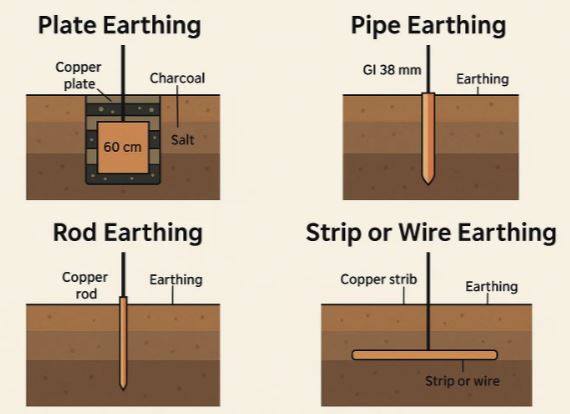
Various types of earthing are shown in the figure:
The necessity of earthing is as follows:
-
To safely conduct current into the ground during a fault, allowing protective devices or safety equipment to isolate the faulty circuit.
-
To ensure that the potential at any point in the system remains at a specific level relative to the ground.
-
To ensure that, during a fault, the voltage of the equipment does not reach a dangerous level relative to the ground.
Current flowing through a human body = Is = 220/1000 = 0.220 A = 220 mA. (Is = Volt / RHuman)
(Resistance of a human being = 1000 ohms)
It is assumed that a human being can withstand a maximum current of 150 mA.
Question: How is earth resistance measured?
Answer: It is measured using a Megger earth tester.
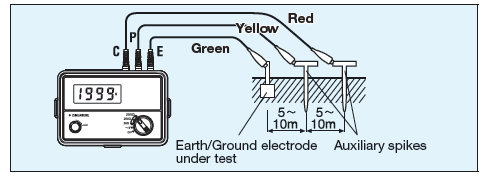
Connect the earth lead as shown in the diagram and press the 'Test' button on the earth tester; the meter will then display the earth resistance. Both digital and analog types of earth testers are shown here. It is advisable to first learn this procedure from someone experienced (it can be learned in less than an hour).
Alternatively, as a rough check, if a 100-watt bulb glows brightly when connected to the earthing line, it indicates that the earthing is effective.
Question: What should the earthing resistance be?
Answer: Generally, the earthing resistance should be a maximum of 5–8 ohms for residential buildings, a maximum of 1–2 ohms for substations, and a maximum of 0.1–1.5 ohms for power plant installations.
Question: What is the color code for an earthing wire?
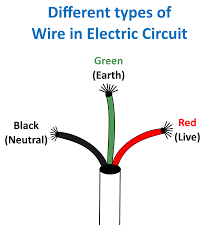
Answer: Color code for an earthing wire: The earthing wire is green. According to current international standards, the live/phase wire is brown, the neutral wire is light blue, and the earth wire is green or yellow (often striped). See the illustration -
Question: Show the electrical wiring for household appliances, including earthing.
Answer: The electrical wiring for household appliances, including earthing, is shown in the figure:
Question: What is the difference between earthing and neutral?
Ans: 1. Earthing is directly connected to the ground, whereas the neutral line returns to the power station or transformer.
2. The neutral line provides a return path (circuit) for the current, while earthing provides safety to the user.
3. During normal operation, current flows through the neutral line; earthing, however, only comes into play during hazardous situations—such as a short circuit—by rapidly directing the electrical current into the ground. In such an event, the fuse blows, thereby protecting both the user and the equipment.
Question: Why is the earth pin in a 3-pin plug larger and thicker?
Answer: In a 3-pin plug, the two thinner pins are used for the flow of electric current, while the third, relatively thicker pin is connected to the earth (ground). The earth pin is also longer than the other two pins; this ensures that when the plug is inserted into a socket, the earth pin makes contact first, and when the plug is removed, it is the last to disconnect.
As a result, any static charge that accumulates on an electrical appliance is directed into the ground, thereby keeping the device safe. Furthermore, the earth pin is designed to be relatively thicker to prevent it from being accidentally inserted into the live or neutral slots. One end of a green-colored wire is connected to the earth pin of the plug, while the other end is attached to the outer metal casing of electrical appliances-such as heaters, irons or table fans.
Question: Describe the procedure for earthing (grounding) in residential buildings.
Answer: The procedures for earthing vary depending on the specific application. In residential buildings, earthing is typically performed by driving a metal rod into the ground. A wire is attached to the top end of this rod and securely connected to the neutral terminal of the main distribution panel. In cases where the soil is dry, rocky, or sandy, a hole deeper than five feet should be dug, and a mixture of water and salt should be added to it.
Next, a metal plate should be placed and connected to an earthing wire, which is then routed outside and connected to the neutral terminal of the main distribution board. Would using a thin G.I. (galvanized iron) pipe for earthing be suitable? This is a technical task; if you are unable to perform it yourself, you should have it done by a qualified electrician. Electrical appliances with metal casings require their bodies to be earthed. For low-voltage (220/440 volts) consumers - such as those in homes or shops - the earth resistance value must be kept below 5 ohms.
Question: Is your computer properly grounded (earthed)?
Answer: For many users, a test light (tester) will glow when touched to the computer monitor (CRT) screen, or one might even receive an electric shock upon touching the device. This occurs when the system is not properly grounded. You should consult an electrician to verify that your home’s electrical grounding is functioning correctly. A lack of proper grounding can sometimes cause hardware components to malfunction. If a computer is not grounded, the monitor may flicker, the metal casing might deliver electric shocks, and components like the motherboard or hard drive could even be damaged. Therefore, a high-quality grounding system is essential for your computer.
Question: What is an earthing switch?
Answer: An earthing switch (ES) is a switch used in transmission lines or substations to discharge any residual charging current in the line to the ground during maintenance. The circuit is first disconnected using an isolator, after which the line is connected to the ground via the earthing switch.

Question: What are the methods to reduce earthing resistance?
Answer: 1. Maintaining proper soil moisture.
2. Using charcoal and salt.
3. Increasing the size of the earthing electrode.
4. Using double earthing electrodes.
Question: What are the components used for earthing?
Answer: 1. Earthing cable, 2. Earthing lead, and 3. Earthing electrode.
Question: How many types of earthing are there, based on the earthing electrode used?
Answer: Based on the earthing electrode, there are four types of earthing:
-
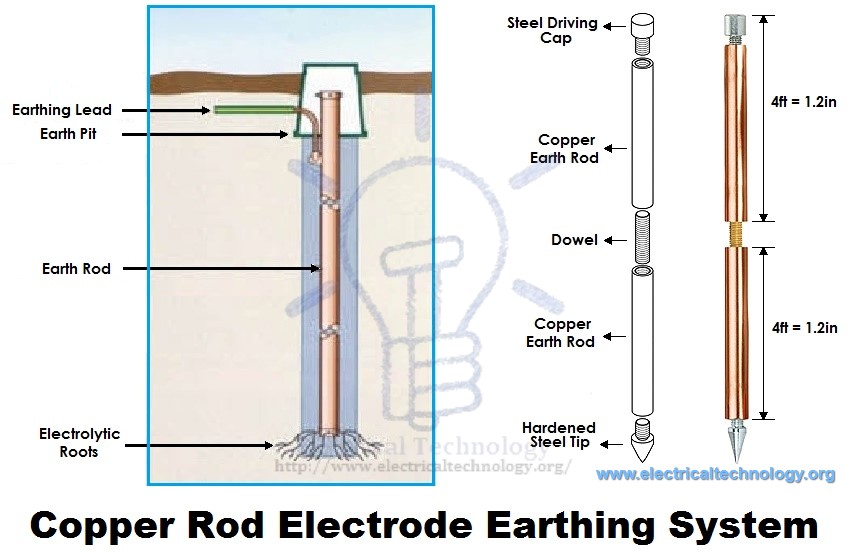
Rod Earthing (Weak) (GI Rod, 7–10 feet)
-
Pipe Earthing (Very Good) (GI Pipe, 8–20 feet)
-
Plate Earthing (Excellent) (Copper plate, used for industrial purposes)
-
Strip Earthing (Normal) (Wire earthing)
- Rod Earthing (Weak): This involves driving a metal rod into the ground and securely connecting a wire from the top end of the rod to the neutral point of the main distribution panel.
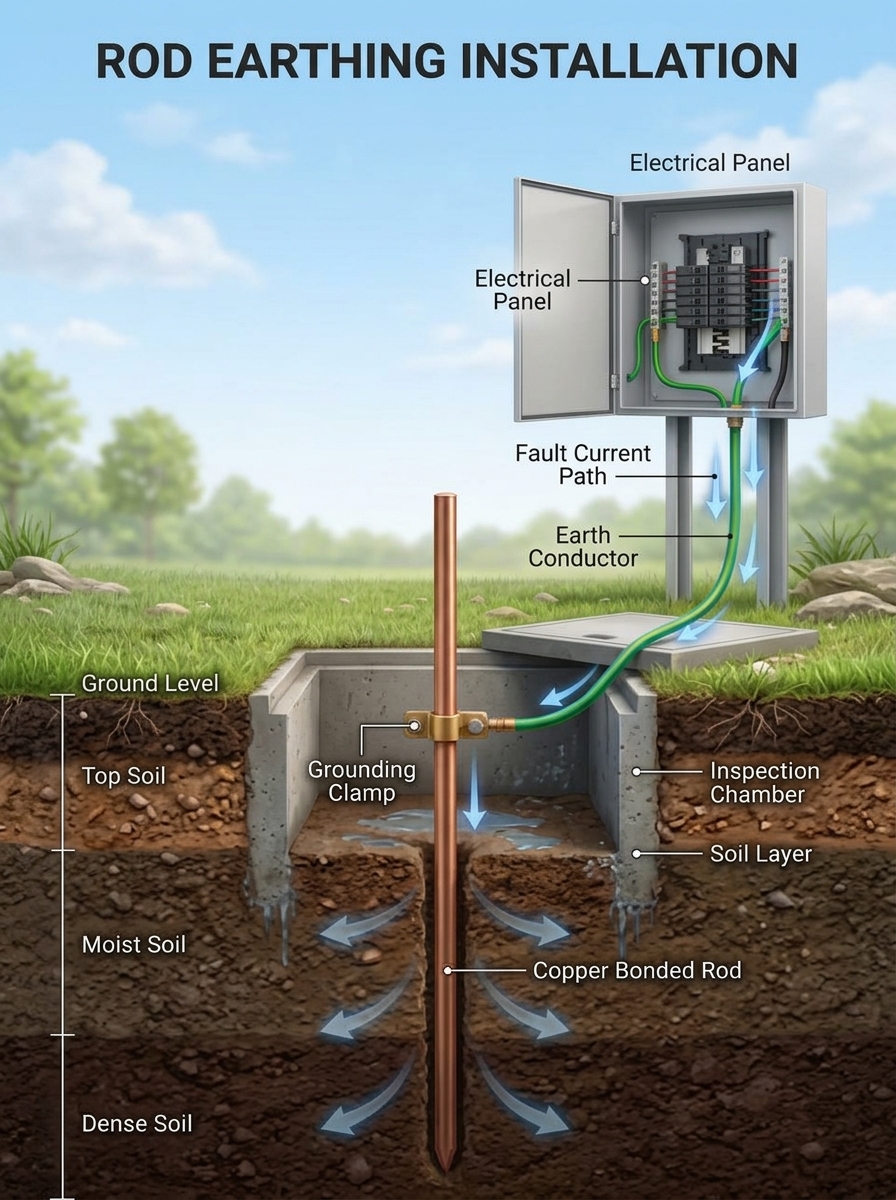
Typically, in sandy, dry, or rocky soil, a hole deeper than five feet is dug, and a mixture of water and salt is prepared and placed inside. A metal rod or a GI (galvanized iron) pipe is then inserted, and an earthing wire is attached to it; this wire is then brought out and connected to the neutral terminal of the main distribution board.
Electrical appliances with metal casings must be earthed. Furthermore, for low-voltage (220/440 volts) electrical installations in homes, shops, and other consumer premises, the resistance must be less than 5 ohms.
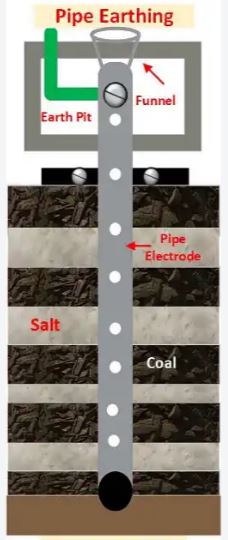
- Pipe Earthing (Very Good): For earthing pipes, we typically use Galvanized Iron (GI) because it is resistant to rust, durable, and cost-effective. Copper pipes can also be used. A GI earthing pipe should have a minimum diameter of 1.5 inches, though 2 inches is preferable. The length of the pipe depends on the specific earthing requirements, but we generally use a minimum length of 7 feet. Small holes should be drilled along the length of the pipe so that when water is poured into the top, it can seep out and moisten the surrounding soil.
Materials required for pipe earthing:
GI pipe (1.5 inches):– minimum 7 feet (a copper pipe may also be used).
Copper wire (No. 8 gauge):– as needed (use No. 6 gauge if using a GI pipe).
Nut-bolt or clamp:– 1 unit.
Charcoal:– 5–7 kg.
Salt:– 5–7 kg.
How to perform pipe earthing:
-
First, gather the necessary materials mentioned above.
-
Next, select a suitable location; this spot should be 5–7 feet away from the building.
-
If the ground is soft and damp, insert the pipe into the soil using a method similar to that used for installing a tubewell.
-
Finally, securely attach the earthing wire to the top of the pipe using a nut-and-bolt assembly or a clamp.
-
If the soil is dry and hard, dig a circular or square hole measuring 8–12 inches, with a depth equal to the length of the earth pipe.
-
Next, pour in a generous amount of water and position the pipe in the center of the hole.
-
Then, fill the space around the pipe with alternating layers of charcoal and salt, and finally, fill the remainder of the hole with soil.
-
Lastly, securely attach the earth wire to the top of the pipe using a nut-and-bolt assembly or a clamp.
-
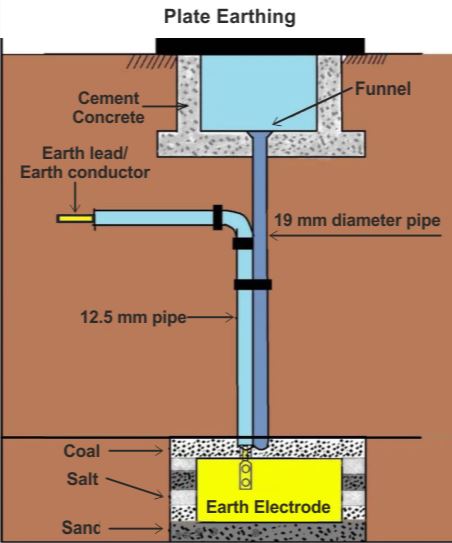
Next, a cement chamber must be constructed at the pipe opening, and a funnel fitted with a mesh screen should be attached to the top of the pipe; this will facilitate pouring water into the pipe while preventing debris from entering it.
However, two factors must be considered when installing a pipe earthing system: 1. Soil type—the soil at the chosen location should be damp or moist. 2. Earth resistance—for residential homes, multi-story buildings, and small to medium-sized factories, the earth resistance should be between 5 and 8 ohms. If the measured earth resistance does not fall within this 5–8 ohm range, an additional pipe earthing system should be installed 5–8 feet away.
- Plate Earthing (Highly Effective): For earthing plates, we typically use either galvanized iron (GI) or copper. These materials are preferred because they are resistant to rust, offer long-term durability and are cost-effective. A GI earthing plate must be at least 1 inch thick and measure 2 feet in its dimensions (rectangular). The length of the pipe section used in an earthing plate varies depending on the type of earthing system; however, we typically use a pipe that is at least 7 feet long. Small holes should be drilled along the length of the pipe so that when water is poured into the top, it can seep out and moisten the surrounding soil. This method is commonly employed in factories, power plants and large substations.