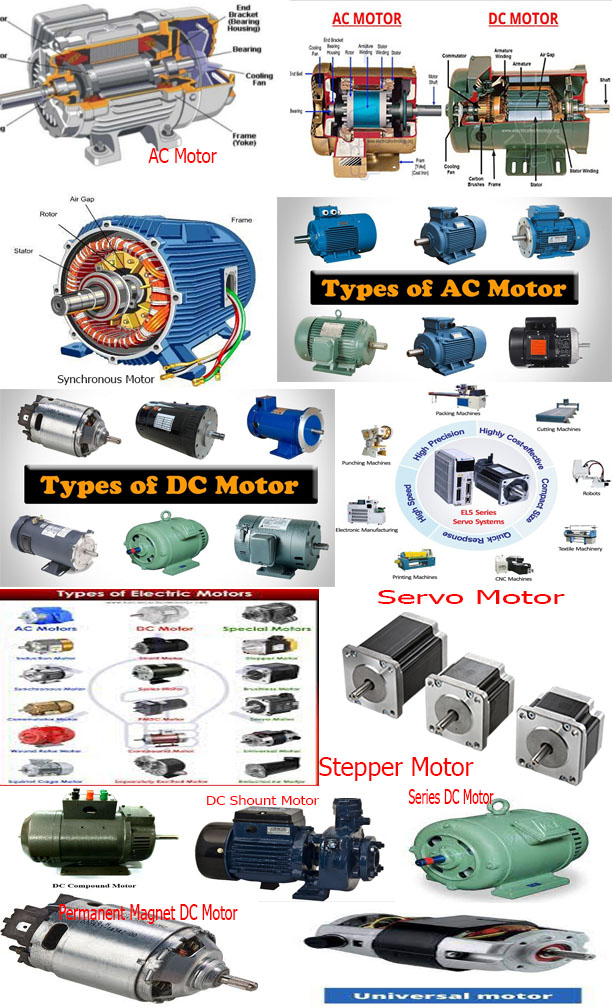
Type of Electric Motor
- AC Motor
- DC Motor
- Synchronous Motor
- Servo Motor etc
Type of Motor
- AC Motor
- DC Motor
- Special Motor
Three Type of Special Motor
- Servo Motor
- Steper Motor
- Universal Motor
Two Type of AC Motor
- Synchronous Motor
- Asynchronous Motor or Induction Motor
Five Type of Asynchronous/Induction Motor
- 1-Ø (Single Phase) Motor
- 3-Ø ( Three Phase) Motor
- Squirrel Cage Motor
- Slippering / Wound Motor
- Linear Motor
Two Type of Synchronous Motor
- Wound Field Motor
- Permanent Magnet Motor
Four Type of DC Motor
- Permanent Magnet Motor
- Series Motor
- Shunt Motor/Separetely Exited Motors
- Compound Motor
Teo Type of Compound Motor
- Long Shunt Motor
- Short Shunt Motor
Four Type of Special Electric Motor
- Universal Motor (AC/DC)
- Servo Motor (AC & DC)
- Stepper Motor(DC)
- Switched Reluctance Motor (DC)
Three Type of Stepper Motor
- Permanent Magnet Stepper Motor
- Variable Reluctance Stepper Motor
- Hybrid Synchronous Stepper Motor
Use of Servo Motor
- Normal Motor
- Gear Motor
- Sensing Device
- Control Unit
Characteristics of a Synchronous Motor:
-
It always operates at a constant speed, from no-load to full-load conditions.
-
A synchronous motor can be operated as an alternator.
-
No slip rings are used.
-
A synchronous motor cannot start on its own (it is not self-starting).
-
The phenomenon of 'hunting' (oscillations) can occur.
-
A synchronous motor can be used as a generator.
Characteristics of an Asynchronous Motor (Induction Motor):
-
An asynchronous motor (induction motor) can start on its own.
-
The speed of an asynchronous motor (induction motor) can be controlled very easily.
-
When the load increases, the speed of an asynchronous motor (induction motor) decreases.
-
The construction and operation of an asynchronous motor (induction motor) are simple.
-
The speed of an asynchronous motor (induction motor) is lower than the speed of a synchronous motor.
-
An asynchronous motor (or induction motor) operates at a lagging power factor.
-
Hunting (or phase oscillation) does not occur in these motors.
-
An asynchronous motor (or induction motor) cannot be used as a generator.
-
A 3-phase asynchronous motor (or 3-phase induction motor) consists of two parts: 1. Stator, 2. Rotor.
-
The rotor of a 3-phase asynchronous motor (or 3-phase induction motor) can be of three types: 1. Squirrel-cage rotor, 2. Wound rotor (with star connection), 3. Double squirrel-cage rotor.
Power Modulators:
- DC - DC Converters --> Chappers
- AC - DC Converters
- DC - AC Converters --> Inverters
- AC - AC Converters
- DC - DC Converters --> Chappers
- Step-Up
- Step-Down
- Step-Up & Step-Down
- AC - DC Converters
- Diode Rectifiers
- Half - Controled Rectifiers
- Full - Controled Rectifiers
- Transformers with Tapchangere + Diode Rectifiers
- Diode Rectifier + DC - DC Converters/Choppers
- DC - AC Converters --> Inverters
- Voltage Source Inverter(VSI)
- Current Source Inverter(CSI)
- AC - AC Converters
- AC Voltage Regulatore
- Cyclo-Converters
DC Power Supplies: Solar Power of Switable Voltage / Power Battery of Switable Voltage --> To meat the load requirment.