Electric Source: An electrical source is a device or a natural mechanism that converts another form of energy (such as mechanical, chemical, thermal or light energy) into electrical energy, enabling electric current to flow through a circuit.
Major Categories of Electric Sources are:
- Electromechanical generator: A device that converts mechanical energy into electrical energy using electromagnetic induction. These devices employ a prime mover (such as a steam, gas, water or wind turbine) to rotate a magnet or a coil of wire within the generator. This is how the majority of grid-supplied electricity is produced.
-
Electrochemical cell (battery): Devices that store chemical energy and convert it directly into electrical energy through chemical reactions occurring between an electrolyte and positive/negative electrodes (e.g. lithium-ion batteries, alkaline batteries and fuel cells).
-
Photovoltaic (solar) cell: A type of semiconductor device that absorbs light energy (photons) from sunlight and through the photovoltaic process, converts it directly into electrical energy specifically DC (direct current) electricity.
-
Thermal sources (thermocouples/thermopiles): Devices that generate electricity directly from the temperature difference at the junction of two different metals or semiconductors (Seebeck effect).
-
Piezoelectric source: Certain materials (such as specific crystals or ceramics) that generate an electric charge when subjected to mechanical pressure, stress or vibration.
Generaly, There are 6(Six) Types of Electric Source:
- Independent Source:
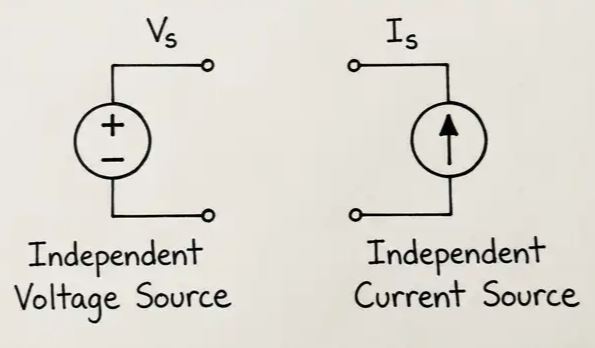
An independent source is an active circuit element that provides a specific voltage or current to an electrical network; its output does not depend on the voltage, current or any other aspect of the circuit elsewhere.
- Dependend Source:
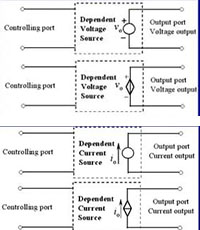
A dependent source (also referred to as a controlled source) is an active circuit element in electrical engineering whose voltage or current output is proportional to a voltage or current measured elsewhere in the network.
- Ideal Voltage Source:
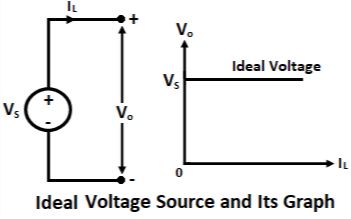
An ideal voltage source is a fundamental theoretical circuit element that maintains a perfectly constant terminal voltage, regardless of the load current drawn from it or the resistance connected to it.
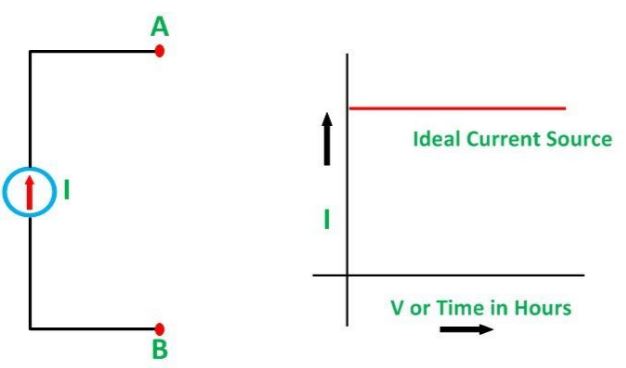
- Ideal Current Source:
An ideal current source is a theoretical circuit element that provides a constant amount of electric current to a circuit, regardless of the voltage across its terminals.
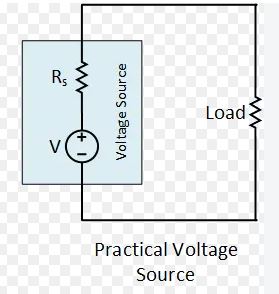
- Practical Voltage Source:
A practical voltage source is a real-world electrical energy source in which a small, finite internal resistance is connected in series with an ideal voltage source. According to Ohm's Law (V) = Vs - I.r. (Here, V = Terminal Voltage, Vs = Open Circuit Voltage, I = Current and r = Internal Serice Resistence)
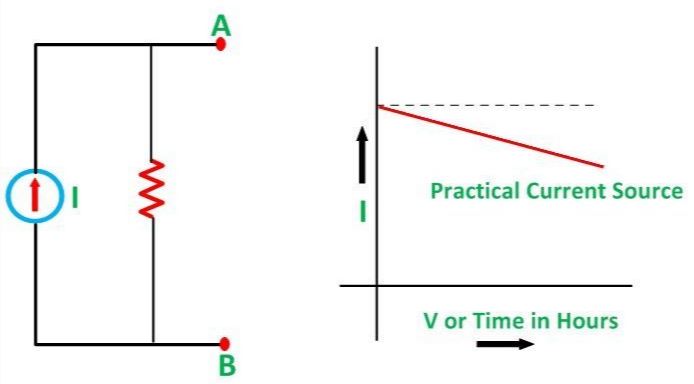
- Practical Current Source:
A practical current source is a real-world electronic device or circuit that supplies electric current to a load; it is modeled as an ideal current source connected in parallel with a finite internal (shunt) resistance. Io = Is - V/Rp (Here, Io = Out put Current, Is = Source Current, V = Voltage and Rp = Internal paralall Shunt Resistance)
There are 2(Two) Types Independent Source
-
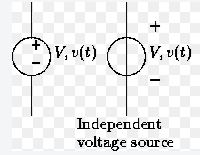
Independent Voltage Source:
An independent voltage source is an active circuit element that maintains a specific potential difference across its terminals, regardless of the amount of current flowing through it or the behavior of other elements in the circuit.
-
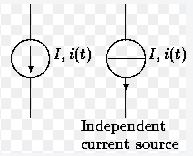
Independent Current Source:
An independent current source is an active circuit element that provides a specific and constant electric current through its terminals, regardless of the potential difference across them.
There areb4(Four) Types Dependend Source
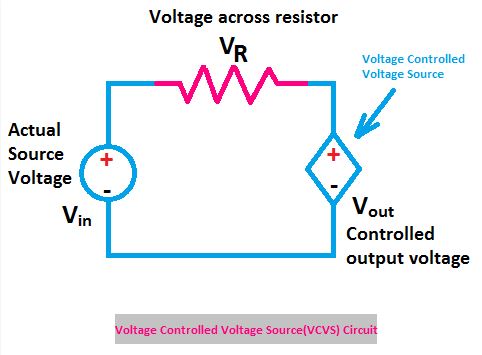
- VCVS - Voltage Control Voltage Source:
A voltage-controlled voltage source (VCVS) is a dependent or controlled electrical source whose output voltage is directly proportional to a voltage measured elsewhere in the circuit. a simple linear equation of output voltage is Vout = µ . Vcontrol (Here, Vout = Controlled output Voltage, µ = Voltage gain and Vcontrol = controlling voltage from another part of the circuit)
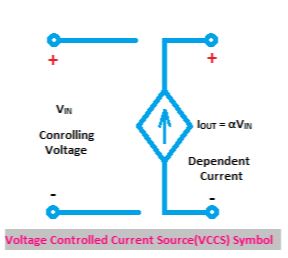
- VCCS - Voltage Control Current Source:
A voltage-controlled current source (VCCS) is a dependent (controlled) electronic source in which the output current is directly proportional to the voltage present elsewhere in the circuit. Output Current (Ioutput) = Gm x Vc (Here, Gm = Transconductance gain and Vc = Controlling Voltage)
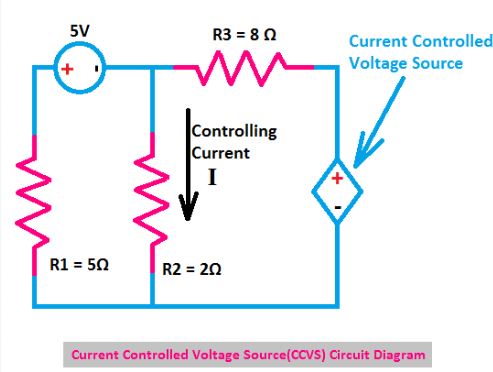
- CCVS - Current Control Voltage Source:
A current-controlled voltage source (CCVS) is a dependent (controlled) electrical source that produces an output voltage proportional to the electric current flowing through a completely separate branch or part of the circuit. The equation of output voltage(Voutput) = Rm . Ic (Here, Rm = transresistance constant/gain and Ic = controlling current)