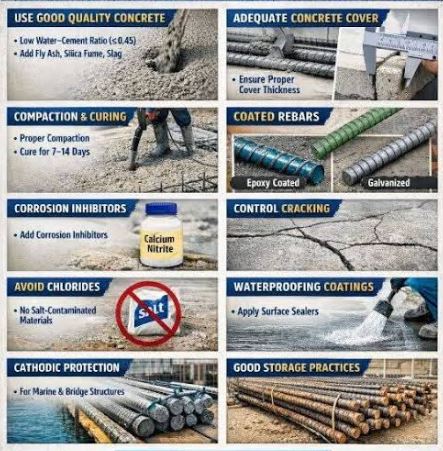
To prevent rust on steel reinforcement bars (rebar), the following points must be observed during their storage and use at a construction site:
-
When storing rebar on-site, it should be placed on a raised platform (skids or dunnage) within a relatively sheltered area; it must never be placed directly on the ground. Contact with mud or soil will lead to the formation of rust, which is a primary factor in reducing the lifespan of the rebar.
-
The rebar must be covered by wrapping it in polyethylene sheeting; otherwise, exposure to rainwater or atmospheric humidity can cause it to rust.
-
In RCC structures, the clear cover must be provided in the correct amount and according to the specified requirements, depending on the type of structure. If the clear cover is less than what is required, moisture can penetrate to the steel reinforcement, leading to the risk of corrosion (rusting).
-
During every RCC casting process, it must be verified that the clear cover is maintained correctly.
-
Broken brick pieces or brick fragments should never be used as spacers (blocks) to maintain the clear cover, as bricks have a high tendency to absorb and transmit water. Furthermore, they also differ in terms of structural strength.
-
If there is a long time gap before constructing the columns on the roof, the column reinforcement bars should be cut at a height of 20–24 inches and encased in a layer of relatively weak concrete; otherwise, the bars will develop rust.
-
Before using reinforcement bars, it is advisable to clean off any mud or clay that may be adhering to them.