
A detailed discussion on beams Question. Author: Engr. Dibakar Dey, IIT-Kharagpur, India
What is a beam? How many types are there and what are they?
Ans: A beam is a type of horizontal structural element that rests on one or more supports such as posts, columns, pillars or walls and transfers the applied loads to those supports.
There are 5 types of beams:
i) Simply supported beam,
ii) Cantilever beam,
iii) Overhanging beam,
iv) Fixed (or restrained) beam, and
v) Continuous beam.
-
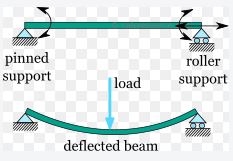
Simply_Supported_Beam: A beam that rests freely on supports at both its ends to carry loads is called a simply supported beam.
-
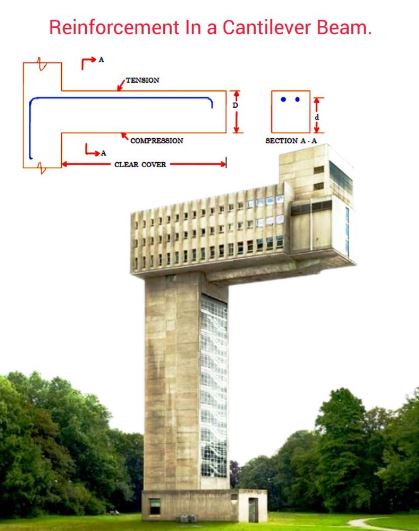
Cantilever beam: A beam that is rigidly fixed at one end while the other end remains free to carry loads is called a cantilever beam.
-
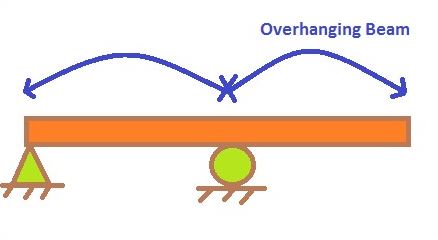
Overhanging beam: A beam that carries loads while one or both of its ends extend beyond the supports is called an overhanging beam.
-
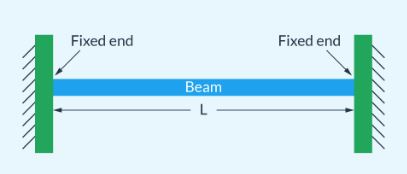
Fixed beam: A beam that carries loads while both of its ends are rigidly fixed to the supports is called a fixed beam.
-
Continuous beam: A beam that rests on more than two supports and carries the loads applied to it is called a continuous beam.
2. What types of loads act on a beam?
A: Three types of loads act on it: i) Concentrated load, ii) Uniformly distributed load, and iii) Non-uniformly distributed load.
3. What kinds of loads are applied to a beam?
A: Three types of loads are applied to a beam: i) Dead load (static load), ii) Live load (moving/dynamic load), and iii) Environmental load.
4. Under what type of force does a beam fail?
A: Tension force.
5. Why are stirrups used in a beam?
Answer: To resist shear force and to control diagonal tension.
6. What are the compression zone and tension zone of a beam?
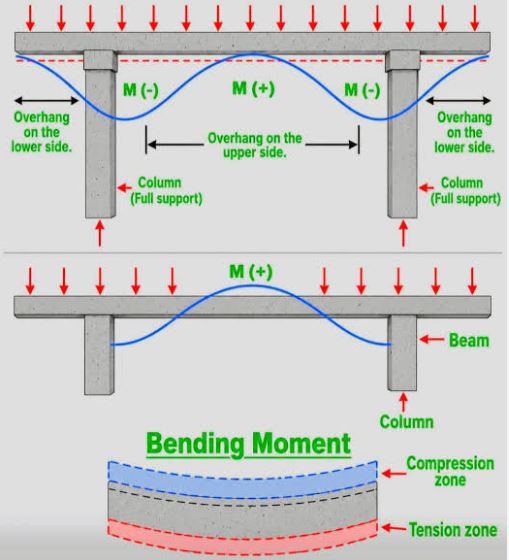
Answer: The area extending from the neutral axis of the beam to its topmost surface is called the compression zone. The area extending from the neutral axis to the bottommost surface is called the tension zone.
7. In what situation can beam failure not be prevented even by using stirrups?
Answer: When the shear stress generated in an R.C.C. beam exceeds the allowable shear stress limits for the concrete and steel.
8. How can an R.C.C. beam fail due to loading?
A: It can fail in three ways: i) failure of the steel in tension, ii) failure of the concrete in compression, and iii) simultaneous failure of the steel in tension and the concrete in compression.
9. Where is the main reinforcement (main bars) placed in a cantilever beam?
A: Since the moment value is always negative, the main reinforcement is placed at the top of the beam.
10. What is a T-beam?
A: A T-beam is formed when a beam and a slab are cast monolithically (poured together), resulting in a combined cross-section that resembles the letter 'T'.
11. What is the minimum concrete cover specified for a beam?
A: 1.5 inches.
12. Why is a beam investigation conducted?
A: A beam investigation is conducted to determine the actual stresses in the beam namely, fc (concrete stress) and fs (steel stress)—in order to verify whether the beam is safe under the applied loads.
13. What is the procedure for cranking the reinforcement bars used in a beam?
A: For simply supported beams, bars are cranked at a distance of L/7 from the supports at both ends. For partially continuous beams, they are cranked at a distance of L/5 from the support at the continuous end; for continuous beams, they are cranked at a distance of L/5 from the supports at both ends.
14. After how long should the vertical formwork (shuttering) and the bottom props (supports) of a beam be removed?
A: The vertical formwork should be removed after 1–2 days, and the bottom props after 7 days.
15. At what ratio is steel reinforcement (rebar) used in RCC beam construction?
A: At a ratio of 1%–2%.
16. Why are cranked bars (bent-up bars) used in beams or slabs?
A: To resist negative bending moments and the maximum shear force that occurs near the supports.
17. What factors should be considered before concrete casting?
A: Before casting, ensure that the formwork and the positioning and spacing of the steel reinforcement are in accordance with the structural drawings; check the clear cover; avoid pouring concrete from an excessive height; keep polythene sheets available in case of rain; ensure proper vibration of the concrete; and, above all, remain present throughout the entire casting process.
18. Why are 'extra top' bars used in beams or slabs?
Answer: To reduce the intensity of the load.
19. What is a concealed beam?
Answer: A concealed beam is also known as a 'hidden beam.' A beam that has the same thickness as the slab is called a concealed beam.
#Details: The concept of a concealed beam originated from the practice used in flat slabs, where additional reinforcement is provided along the column strips. In engineering, there is no such thing as a truly effective "concealed beam." Such beams should not be used in any slab with a thickness of less than 200 mm. In fact, the use of concealed beams should be avoided altogether. If their use is unavoidable, the entire model including the slab must be analyzed, rather than just the beam itself. Furthermore, the punching shear at the columns must be verified when concealed beams are employed.
20. Details regarding Beams and Stirrups:
Types of Beams:
1. Simply Supported Beam: Supported at both ends (one hinged and one roller). It allows for free rotation and resists vertical loads.
Used in residential buildings, bridges, etc.
2. Cantilever Beam: Fixed at one end and free at the other. It carries bending moments and shear forces at the fixed end. Used for balconies and canopies.
3. Fixed Beam: Rigidly fixed at both ends. There is no rotation at the supports. Results in minimal deflection. Used in continuous frames and industrial structures.
4. Continuous beam: Has more than two supports. It reduces bending moments and deflections. Used in bridges and multi-span structures.
5. Overhanging beam: Extends beyond its supports. It combines the characteristics of a simply supported beam and a cantilever. Used for verandas and balconies.
6. T-beam: The slab acts as a flange integrated with the beam web. Common in RCC (reinforced cement concrete) slabs and bridges.
7. L-beam (edge beam): Features a flange on only one side. Used at the edges and perimeter of a slab.
8. Box beam: A hollow, rectangular section. Possesses high torsional rigidity. Used in bridges and flyovers.
9. I-beam / H-beam (steel): A steel beam with an I or H-shaped cross-section. Offers high resistance to bending. Used in steel structures.
10. Composite beam: Constructed using two different materials (e.g., steel and concrete). Combines strength with cost-efficiency. Used in bridges and multi-story buildings.
What is a stirrup?
A stirrup is a closed-loop reinforcement bar used in beams and columns to hold the main longitudinal bars in position and to resist shear and torsional stresses.
Types of Stirrups
1. Single-leg stirrup
2. Two-leg (rectangular) stirrup
3. Four-leg stirrup
4. Circular stirrup
5. Helical stirrup
6. Diamond stirrup
7. Spiral stirrup
Example of Beam Stirrups
For a 230 mm × 450 mm beam:
Main bars: 4 (2 at the top + 2 at the bottom)
Stirrups: 8 mm diameter, spaced at 150 mm near the supports and 200 mm in the middle (between supports).
Bar Bending Schedule (BBS) for stirrups
Length of one stirrup
= 2 × (width + depth) + (hook allowance) – (concrete cover on both sides)
Example:
Beam = 230 × 450 mm, cover = 25 mm, bar diameter (Ø) = 8 mm
→ (2 × (180 + 400)) + (2 × 10 × 8) = 1160 mm (approx.)