
Steel rods are an important component in house construction. Author: Engr. Dibakar Dey, IIT-Kharagpur, India.
Steel rods are a crucial component in house construction. Do not build your dream home using low-quality steel rods. Therefore, today we will discuss steel rods:
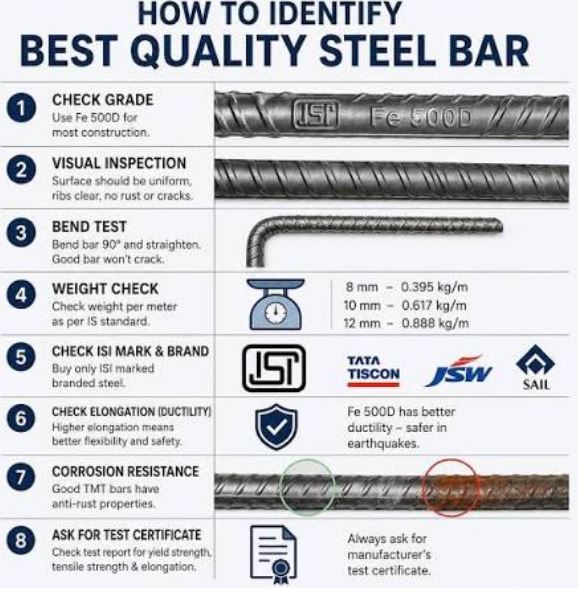
1. How can one identify good-quality steel rods (rebar)?
2. What does "500W" marked on a steel rod signify?
3. What is meant by "Grade 72" or "Grade 60" steel rods?
4. What does "400W/500W" mean when marked on a steel rod?
5. MS = Mild Steel (Medium Carbon Steel)
There are three types of steel rods:
1. Low Carbon Steel
2. Medium Carbon Steel
3. High Carbon Steel
What is meant by the "grade" of a steel rod?
- The grade of a steel rod refers to the maximum strength at its yield point.
What is meant by Grade 72 steel?
- Grade 72 steel refers to steel (rebar) with a yield strength of 72 KSI (kips per square inch). Markings such as 400W, 500W, or 550W found on rebar indicate strength in megapascals (MPa). One megapascal is equivalent to 145 psi (pounds per square inch). It is also worth noting that 1 kg is approximately 2.206 pounds. For instance, 400 MPa multiplied by 145 psi/MPa equals 58,000 psi. Since 1 kip equals 1,000 pounds, this value is often rounded to 60,000 psi a figure frequently used by manufacturers to define the strength of the rebar. Some steel bars are marked with "60 G," which means they can withstand a load of 60,000 psi (pounds per square inch); applying a load beyond this limit will cause the bar to break. The letter "W" indicates that the bar is "weldable." Often, bars are also marked with "TMT," which stands for "Thermo-Mechanically Treated"—a process involving specific thermal and mechanical treatments.
The following is inscribed on the steel rod:
1. MK/500/W/16
2. ANOWER/415/W/20
3. MK/500/W/16
MK = Company Name
500 = 500 Megapascals (MPa)
1 MPa = 145 PSI (pounds per square inch); 1 ksi (kilopound per square inch) = 1000 PSI
W = Weldable
16 = 16 mm rod
How do I determine the grade of a rod labeled "500W"?
500 × 145 = 72,500 PSI
72,500 / 1,000 = 72.5 ksi ~ Grade 72
How to identify high-quality steel rods.
- Using substandard steel rods in building construction increases the risk posed by earthquakes or natural disasters. There is simply no substitute for using high-quality rods; doing so significantly reduces the risks to a building. Therefore, it is essential to verify the quality of the rods before purchasing them. A variety of steel rods are available on the market, ranging in diameter from 3 mm to 4, 5, 8, 10, 12, 16, 20, and 25 mm. However, three specific types of rods are most commonly used in building construction.
Different types of steel rods are used for constructing elements such as piles, slabs, beams, or columns. A high-quality rod is one that forms a strong bond with concrete. Rods available in the market come in various grades, including 40, 60, and up to 72.5. Grade 40 rods are now rarely used; Grade 60 rods are the most commonly used for building construction. Grade 72.5 rods are considered an "extreme" grade and are frequently used in the construction of high-rise buildings. Generally, steel rods are categorized into two types: mild steel (MS) and stainless steel (SS).
Testing Steel Rods:
- Must have BSTI certification and BUET certification.
- Each rod must bear a trademark.
Bend Test:
- The rod should be capable of being bent to an angle between 90 and 135 degrees and then straightened again; if it fails this, it is not a high-quality rod.
- No cracks should appear after the rod is bent and subsequently straightened.
- A key indicator of a good-quality rod is that it will not show signs of rust or any cracks.
- Deformed (ribbed) steel bars should be used instead of plain bars, as they form a stronger bond with concrete.
Storage of steel at the construction site:
- Steel must be stored in a dry place. Care should be taken to prevent the formation of rust.
- It should not be left in an open area for more than one month.
- If minor rusting occurs, the steel must be cleaned before use.
- If it becomes necessary to store the steel outdoors for longer than a month, it should be washed with a cement-water slurry (cement wash).
High-quality steel rods possess certain characteristics that are absent in ordinary rods. These features are outlined below:
Durability and Strength: Steel rods have a property known as "yield strength," which refers to their capacity to withstand pressure. The higher the yield strength of a rod, the better it is for house construction. Currently, the best rods available on the market have a yield strength of 500 MPa (72,000 PSI). Steel rods also play a role in protecting a house from earthquake-related damage; therefore, it is advisable to verify whether the rods you intend to purchase are earthquake-resistant.
Good Weldability: Various issues can arise when welding standard steel rods one of which is an increased tendency toward embrittlement (making the rods brittle). Furthermore, standard rods may warp or bend as they cool down after welding, which creates complications during construction. When purchasing steel rods, ensure you select those that are free from these issues. Opt for rods with a low carbon content; such rods are suitable for butt welding or lap welding, which can help save time during the construction process.
Corrosion resistance: High-quality steel rods are produced using a thermo-mechanical treatment process. As a result, these rods are free from harmful torsional residual stress, which gives them a significantly higher level of corrosion resistance.
Ductility: To ensure the long-term durability of the concrete used in the construction of your home, you need ductile steel rods; high-quality, ductile rods help prevent cracks from forming in the concrete. Steel rods manufactured using modern quenching and tempering processes exhibit greater ductility. When purchasing steel rods, you may also want to inquire about their carbon content, as rods with a lower carbon content are more ductile.
Consistency: Since you will be purchasing a large quantity of steel rods, you should ensure that all of them are of uniform quality. In the production of high-quality rods, the 'quenching and tempering' process is applied consistently every time. As a result, the composition of the rods remains unchanged, ensuring there is no variation in quality among them.
Perfectly Straight: Straightening steel rods at a construction site is a time-consuming and labor-intensive task. Therefore, ensure that the rods are straight at the time of purchase.
Cost-Efficiency: If the steel rods you select possess higher yield strength, ductility, and weldability, your construction costs will decrease, while also saving time and reducing the physical effort required by the workers.
1. What is 'rod' or iron?
Answer: The state intermediate between cast iron and wrought iron is referred to as 'rod' or iron.
2. What is the meaning of the term 'reinforcement'?
Answer: To strengthen or fortify.
3. In how many ways is steel used in concrete?
Answer: In two ways (reinforcing steel and pre-stressing steel).
4. Into how many categories can rods be classified based on their surface texture (smoothness)?
Answer: 2 categories (smooth and rough/deformed)
5. What types of steel are used as reinforcement in R.C.C. (Reinforced Cement Concrete) work?
Answer: Plain, deformed, twisted, and square bars.
6. What is referred to as the 'bones' of a building?
Answer: The rods (reinforcement bars).
7. How many types of steel are there based on their carbon content?
Answer: 2 types (mild steel and stainless steel).
8. Why are steel rods (rebars) used in construction work?
Answer: To provide protection against tensile stress.
9. Which grades of steel rods are used in the construction of buildings, including high-rise structures?
Answer: Grade 60 and Grade 72.5.
11. What is the weight of a 12-meter-long steel rod with a diameter of 16 mm?
Answer:
w = d²/162.2 × L
16 × 16 / 162.2 × 12
= 18.96 kg
12. What are deformed or twisted bars?
Answer: Bars with an uneven (textured) surface are called deformed or twisted bars.
13. How many millimeters are equal to one 'suta' (1/8 inch)?
Answer: 25.4 / 8 = 3.175 ~ 3.2 mm.
14. What is meant by billet steel and scrap steel?
Answer: Steel produced from iron ore is called billet steel. Steel produced by melting down unwanted pieces of iron (scrap) is called scrap steel.
15. By what percentage is the bond strength of deformed bars higher than that of M.S. (mild steel) bars?
Answer: 40–80%.