
What are current, voltage and resistance? Plus, answers to many other questions that are essential for job examinations... Author: Engr. Dibakar Dey, IIT-Kharagpur, India
1. What is current? Who discovered it and in what year?
Current is defined as the rate at which free electrons within a conductive material flow in a specific direction. It is denoted by the symbol I (or i), and its unit is the ampere (A or Amp.) or coulombs per second.

Who discovered electricity and in what year? Who introduced the first electricity supply system?
British scientist Michael Faraday discovered the fundamental principles of electricity generation during the 1820s and 1830s. Electricity continues to be generated today based on these foundational principles he discovered; hence, he is considered the discoverer of electricity. Thomas Alva Edison, meanwhile, introduced the first electricity supply system.
2. What is voltage?
The force or pressure required to displace the free electrons of the atoms in a conductive material is called electromotive force or voltage. It is denoted by the symbol V, and its unit is volts.

3. What is resistance?
The property or characteristic of a conductive material that hinders the flow of electric current through it is called resistance. Its symbol is R or r, and its unit is the ohm (Ω).

4. What is a transformer?
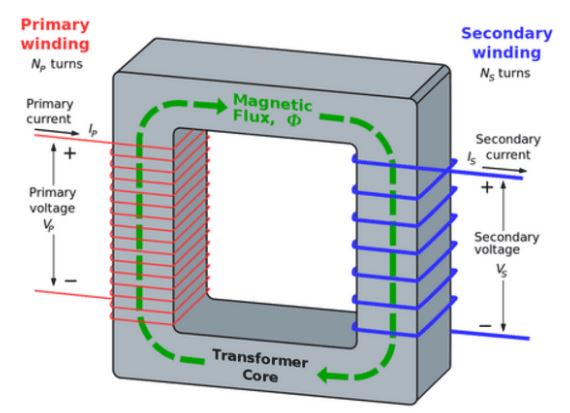
A transformer is an electrical machine that converts alternating current (AC) from one voltage level to another. Transformers can be of two types—step-up or step-down—and they operate based on the principle of magnetic induction. A transformer contains no moving or rotating parts; it is a completely stationary device. It consists of two windings: a primary winding and a secondary winding. When voltage is applied to the primary winding, a magnetic field is generated; the magnetic flux then travels through the iron core to the secondary winding, where it creates a magnetic field.

As a result, a voltage is obtained in the secondary coil. The rate at which a transformer changes voltage depends on the ratio of the number of turns in the primary and secondary coils. However, keep in mind that a transformer only changes the voltage; the power and frequency remain unchanged. Since the power remains constant, a change in voltage is accompanied by a corresponding change in current.

5. What is the transformation ratio?
Answer: The induced voltages and currents on both sides of a transformer maintain a specific ratio with the number of turns in the coils; this is known as the transformation ratio or turns ratio. It is typically denoted by 'a', i.e., a = Ep/Es = Np/Ns = Is/Ip.

6. What are instrument transformers?
CTs (Current Transformers) and PTs (Potential Transformers) are known as instrument transformers.
CT (Current Transformer): This is typically used to measure high levels of current in a circuit using a low-range meter.
PT (Potential Transformer): This is typically used to measure high levels of voltage in a circuit using a low-range meter. When CTs and PTs are used in this manner, they are referred to as instrument transformers.

7. What is a circuit breaker?
A circuit breaker is an electrical switching device used to connect or disconnect an electrical circuit from its power supply. It functions as a control and protection device for electrical circuits. In the event of an overload or a short circuit, it automatically disconnects the electrical circuit from the power supply. However, a circuit breaker does not automatically reconnect the circuit.

8. What is an isolator?
An isolator is used in an electrical substation to disconnect various equipment most notably transformers from the line while in a no-load or very light-load condition. In other words, an isolator is a type of switch that is operated while the circuit is offline (de-energized).

9. What is a sub-station?

In a power system, a substation is a facility equipped with various apparatus that facilitate the adjustment of electrical parameters such as voltage, AC/DC conversion, frequency and power factor. Such a facility is known as a substation.

10. What is Power Line Carrier (PLC)?
A line that facilitates dedicated emergency communication via telephone between power stations, substations, and receiving stations is known as a Power Line Carrier (PLC).

11. What is the Q-factor?
In an AC circuit, during series resonance, the voltage across the L (inductance) or C (capacitance) component increases to many times the value of the applied voltage. This rise in voltage, occurring due to resonance, is known as the Q-factor (Quality Factor) of a series resonant circuit.

12. What is power factor?
Power factor is the ratio of active power that is, the power we can actually use to apparent power. It is represented by cosθ and its value ranges from 0 to 1.
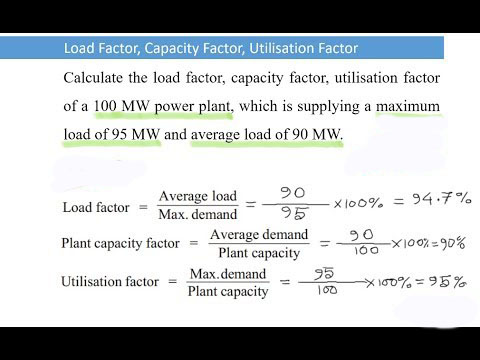
13. What is load factor?
The ratio of the average load to the maximum demand is called the load factor.
Load Factor = Average load / Max. Demand (or Peak load). Its value is less than 1.
14. What is Plant Factor?
The ratio of the average load and the rated capacity of a power plant is called Plant Factor.
Plant Factor = Average load/ Rated capacity of the plant

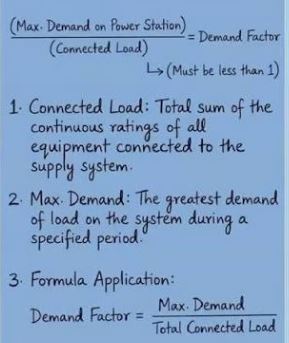
15. What is the demand factor?
The ratio of the maximum demand of a plant to its connected load is called the demand factor.
Demand Factor = Max. Demand / Connected Load.
16. What is the form factor?
The ratio of the root-mean-square (RMS) value of a sine wave to its average value is called the form factor. It is denoted by Kf and has a value of 1.11.


17. What is meant by 'peak factor'?
The ratio of the maximum value to the effective value (RMS value) of a sine wave is called the peak factor. It is denoted by Ka and has a value of 1.41.

21. What is the Ferranti effect?
In medium or long transmission lines, when operating under open-circuit conditions, with no load, or under a very light load, the voltage at the receiving end is found to be higher than the voltage at the sending end. This phenomenon is known as the Ferranti effect.
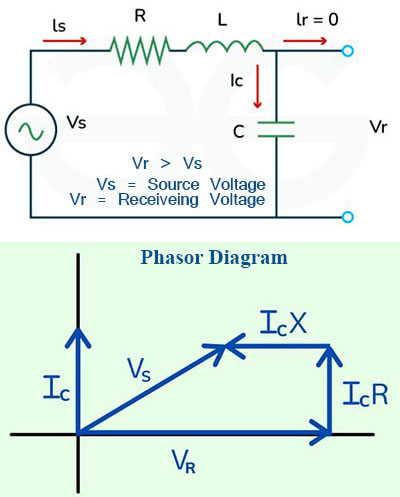
OR, The Ferranti effect is a phenomenon occurring in long alternating current (AC) transmission lines where, under light-load or open-circuit (no-load) conditions, the voltage at the receiving end becomes higher than the voltage at the sending end. The resulting reactive voltage drop is approximately in phase with the sending-end voltage, causing the voltage at the receiving end to exceed that at the sending end (Vr > Vs).
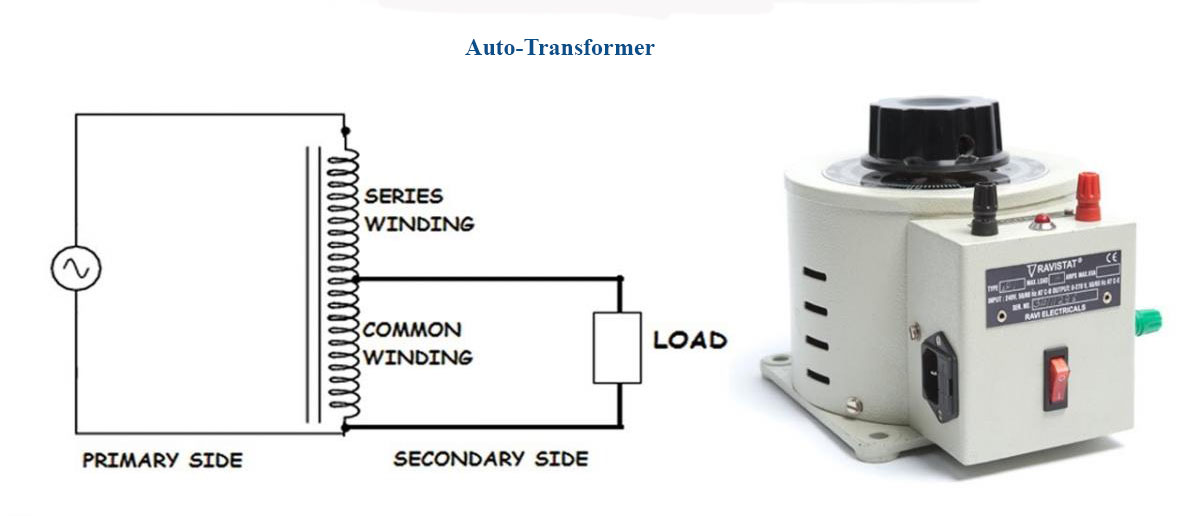
22. Explain the auto-transformer.
An auto-transformer is a unique type of transformer that consists of only a single winding. A portion of this winding serves as the primary, while another portion acts as the secondary; the two sections are connected both electrically and magnetically. It is still classified as a transformer because its operating principle is the same as that of a two-winding transformer.
23. What is specific resistance or resistivity?
At a given temperature, the resistance between two opposite faces of a conducting material having a unit length and a unit cross-sectional area, or in the form of a cube with a unit side length is called the resistivity (or specific resistance) of that conductor.

24. What is resonant frequency?
In an AC circuit, regardless of the values of inductance and capacitance, the frequency at which the circuit's inductive reactance (XL) and capacitive reactance (XC) are equal is called the resonant frequency. It is denoted by fr.

25. What is a relay?
A relay is an automatic device that, upon the occurrence of a fault in an electrical circuit, automatically operates the circuit's protective devices and isolates the faulty section from the healthy (fault-free) section, thereby preventing damage.

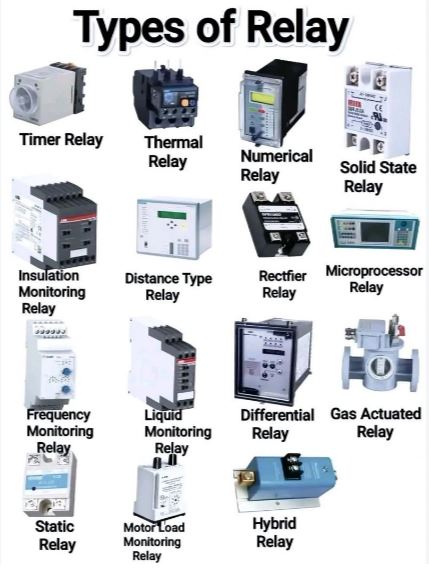
26. Name a few types of relays.
a) Primary relay, b) Secondary relay, c) Directional relay, d) Differential relay, e) Thermal relay, f) Electro-thermal relay, g) Reverse power relay, h) Solenoid and plunger relay, i) Distance relay, j) Over-voltage and over-current relay.
27. Where is a reverse power relay used?
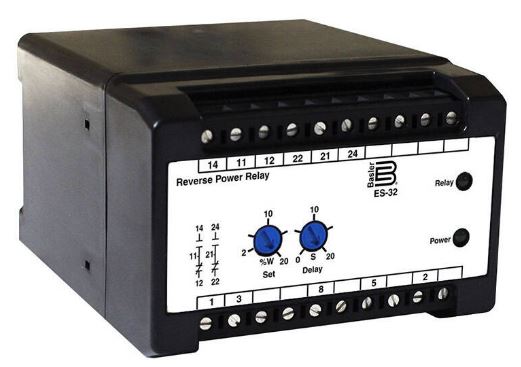
In parallel operation, if the input to an alternator is cut off for any reason or due to some other fault the alternator may begin drawing power from the busbar (i.e. receiving power in the reverse direction), causing it to function as a motor. A reverse power relay is used to provide protection in such a scenario. Under these conditions, the reverse power relay becomes energized and trips the alternator's circuit breaker, thereby protecting the system.

28. Where are thermal relays used?
A relay that responds to a rise in temperature—caused by an increase in current is called a thermal relay. It is typically used in motor control circuits as well as in balanced and unbalanced three-phase circuits.


29. Where are differential relays used?
A differential relay is a device that operates when the vector difference between two or more electrical quantities (such as magnitude or direction) exceeds or falls below a predetermined value; it functions to protect the system or electrical equipment.


30. Tell us about HRC fuses.
'HRC' stands for 'High Rupturing Capacity'. Fuses used in lines that carry high currents are known as HRC fuses. They consist of a fuse wire housed within a ceramic (porcelain) casing. The space around the fuse wire is filled with sand or chalk powder, and the two ends of the casing are sealed with brass caps. The fuse wire is connected to both of these caps.

31. What are BPDB and PGCB?
BPDB (Bangladesh Power Development Board): This is the sole entity in Bangladesh responsible for the generation of electricity. No other company is permitted to carry out electricity generation.
PGCB (Power Grid Company of Bangladesh): This company is the sole entity responsible for power transmission across the entire country of Bangladesh. In other words, their primary function is to transmit electricity from one location to another within the nation.
32. How is earth resistance measured?
A: It can be measured using a Megger earth tester. Alternatively, as a rough check, one can connect a 100-watt bulb to the earth line; if it glows brightly, the earthing is in good condition.

33. Can a star-delta starter, purchased for a 20-horsepower (HP) three-phase motor, be used for a 10-horsepower three-phase motor?
A: Yes, it can be used; however, the current setting must be adjusted to a lower value.
34. What voltage is supplied to the magnetic coil of a star-delta starter?
A: It receives a direct 400-volt supply (line-to-line).


35. If one terminal of a test lamp is connected to the body of a three-phase motor and the other terminal is connected to the supply and the lamp lights up fully, what does this indicate?
A: The motor body is properly earthed.
36. With what instrument is insulation resistance measured?
A: With a Megger.
37. What happens if one phase of a three-phase motor is lost while it is running?
A: If the motor is running without a load, it will continue to rotate but will heat up and produce an unusual noise. If it is under load, the motor will stop immediately. If the main switch is not turned off, the motor will burn out.
38. What is the desirable value for earthing resistance?
A: It should be a maximum of 5 ohms for residential premises, and a maximum of 1 ohm for substations and power lines.
39. Which type of transformer has only one coil?
A: An auto-transformer.
40. Is it possible to provide a three-phase supply using a single-phase transformer?
A: Yes, it is possible by using a V-V (open-delta) connection.
41. What is transformer humming?
A: If the core and coil connections of a transformer are not secured firmly that is, if there are loose connections the transformer will vibrate under full-load conditions, producing a specific type of sound; this is known as "humming."
42. What are the reasons for a transformer heating up?
A: (1) It may occur due to overloading.
(2) It may happen if the insulation becomes weak.
(3) It may occur if there is a ground fault (earthing) somewhere.
(4) It may be caused by an over-voltage supply.
43. What is the normal color of silica gel?
A: In good condition, it is pure white; however, it turns somewhat brownish upon absorbing water vapor. It reverts to white when heated.
44. What is the function of transformer oil?
A: It has two primary functions: first, it acts as an insulator; second, it helps to keep the transformer cool.
45. What is a breather?
A: It is attached to the transformer's conservator tank. Through it, cool air from the outside is filtered before entering the tank, while warm air is expelled from the tank.
46. What is a Buchholz relay?
A: It is a type of relay installed in the pipe connecting a transformer's tank to its conservator; it triggers an alarm if a fault occurs inside the transformer.

47. What is a guard wire?
A: A wire used beneath a transmission line that is connected to the earth (ground).
48. When preparing a battery solution, should the acid be added to the water, or the water to the acid?
A: The acid should be added to the water.
49. What is a jumper?
A: A wire that provides a connection from the main line to the supply line for a house or building.
50. What is a damper winding?
A: It is a winding made of thick wire placed on the poles of a synchronous motor to facilitate its starting; it is also used in alternators to reduce the phenomenon known as 'hunting'.
51. What is a C.B. (Circuit Breaker)?
A: A circuit breaker is a device that automatically disconnects a faulty line from the power source.
52. How are AC converted to DC, and DC converted to AC?
A: AC is converted to DC using rectifiers or rotary converters, while DC is converted to AC using an inverter.
53. What is the difference between electrical and electronics?
'Electrical' deals with the sources and supply of electric current, as well as various matters related to electrical circuits; it operates using AC (alternating current).
'Electronics', on the other hand, is a branch of electrical engineering that focuses on the flow, control, practical behavior and processes of electrons through vacuum tubes, gases or semiconductor components. It operates using DC (direct current).
54. What is the main difference between AC and DC?
AC is a bidirectional (two-way) flow, while DC is a unidirectional (one-way) flow.
AC is a bidirectional flow of electricity—the type we use in homes or industries, supplied by power utility grids. DC is a unidirectional flow of electricity, which we obtain from sources like batteries.
AC = Alternating Current
DC = Direct Current
AC is an alternating (variable) flow of electricity.
DC is a non-alternating (constant) flow of electricity.
AC is a flow that changes direction specifically, it reverses direction 50 to 60 times per second. On the other hand, DC is a non-alternating flow; it does not change its direction over time.
55. Does a fan consume the same amount of electricity regardless of whether it is set to a low or high speed?
We generally use two types of fan regulators: (a) electrical regulators and (b) electronic regulators. An electrical regulator is constructed using an inductor with multiple tappings. When an electric fan is in operation, reducing the speed via this type of regulator decreases the fan's rotation, but it also causes the regulator itself to heat up. This unnecessary heat results in the consumption of electrical power. Consequently, when an electrical regulator is used, the power loss within the regulator varies increasing as the fan speed is reduced and decreasing as the fan speed is increased with the result that, regardless of the fan's speed, the total electricity consumption remains roughly the same.
On the other hand, electronic regulators are constructed using electronic switching devices such as thyristors. Since they generate a negligible amount of unwanted heat, there is virtually no power loss within the regulator. Consequently, reducing the speed of an electric fan lowers its power consumption, while increasing the speed raises it. Therefore, when an electronic regulator is used, running a fan at a lower speed results in lower electricity consumption.
56. How are a voltmeter and an ammeter connected in a circuit?
A voltmeter is connected in parallel across the two points of an electrical circuit between which the potential difference is to be measured. On the other hand, an ammeter is connected in series within an electrical circuit to measure the electric current.
An ammeter must be connected in series with the circuit, while a voltmeter must be connected in parallel.
57. What is the difference between a transducer and a sensor?
Transducer – Its output is generally analog. It is typically used to measure pressure. Its output range is usually 0–10V or 0–20mA.
Construction: It consists of a diaphragm equipped with a coil, positioned around a cylindrical iron or magnetic rod (i.e. the diaphragm is arranged around this cylindrical rod).
Under the influence of pressure, the diaphragm moves up and down along the core, causing variations in the electrical current flowing through the coil. The output is determined by calculating these variations in the electrical current.
And standard sensors provide a digital output.
I hope you understand.
Devices that convert one form of energy into another are called transducers.
When a transducer is used as a component within a device designed for a specific purpose, it is referred to as a sensor for that device.
58. What is an ampere-turn?
An ampere-turn is the product of the number of turns of wire in a magnetic circuit and the current flowing through it. It is the unit of magnetomotive force (MMF).
If the ampere-turn is denoted by AT, the current by I, and the number of turns of wire by N, then:
AT = IN
59. What is reluctance?
Reluctance is the opposition to the path of magnetic flux.
It is analogous to resistance in an electric circuit. Its symbol is R, and its unit is ampere-turns per weber (At/Wb).
Given length L, absolute permeability µ, absolute permeability in a vacuum µ₀, and cross-sectional area A:
R = L / (µ₀µA)
60. What is an electrostatic field?
An electrostatic field is the region in which a single charge experiences a force.

61. What are the characteristics of electric lines of force?
1. Electric lines of force originate from a positive charge and terminate at a negative charge.
2. These lines of force are open and curved.
3. Lines of force never intersect each other.
4. Lines of force tend to contract along their length.
5. Lines of force exert a lateral pressure on one another.
62. State Ohm's law and provide an explanation for it.
Answer: Ohm's Law: “At a constant temperature, the current flowing through a conductor is directly proportional to the potential difference across its two ends and inversely proportional to its resistance.”
Explanation of Ohm's law:
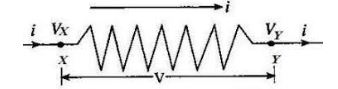
Here, "proportional" means that if the potential difference across the two ends of a conductor is doubled, the electric current flowing through the conductor will also double. Conversely, if the potential difference across the two ends of the conductor is reduced to one-third, the electric current flowing through the conductor will likewise become one-third.
If a current of "I" amperes flows through a conductor, the potential difference between the two ends of the conductor is Vy - Vx = V volts and the resistance is R ohms, then according to Ohm's law:

I = V / R

Where,

I = current (amperes),

V = voltage or potential (volts),

R = resistance (ohms).
Since I = V / R (i.e. current = voltage / resistance),
it follows that V = I x R (i.e. voltage = current x resistance),
and R = V / I (i.e. resistance = voltage / current).
In other words, an increase in voltage leads to an increase in current, while a decrease in voltage leads to a decrease in current. Conversely, an increase in resistance results in a decrease in current, and a decrease in resistance results in an increase in current.