
What are the components of a modern AC power system? Plus, some related questions and answers...Author: Engr. Dibakar Dey, IIT-Kharagpur, India
What is AC Power upply?
Answer: An AC power supply is an electrical system or device that provides power in the form of alternating current (AC); this means that the flow of electric charge periodically changes direction.
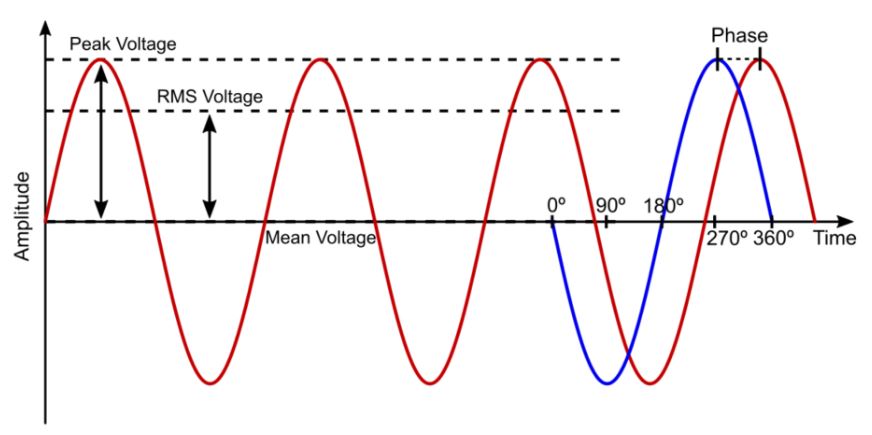
How it works
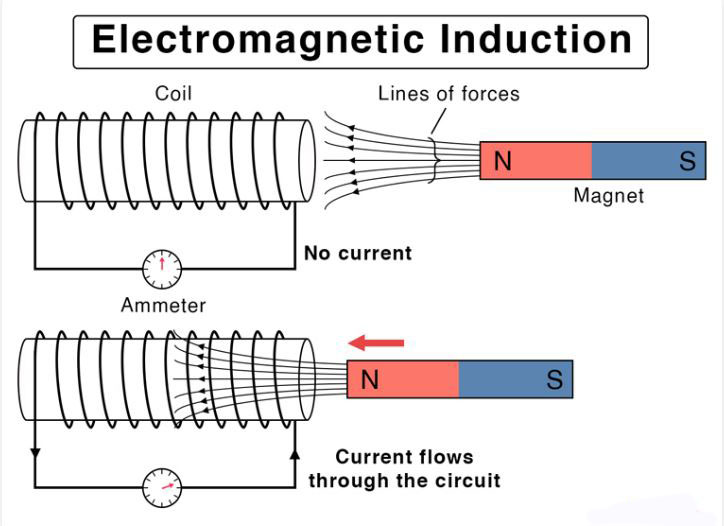
• Electromagnetic induction: In power plants, alternating current (AC) is typically generated by a rotating mechanical turbine (driven by water, steam or wind) that spins a magnet around a stationary coil of wire, producing an alternating voltage (usually in the form of a sine wave).
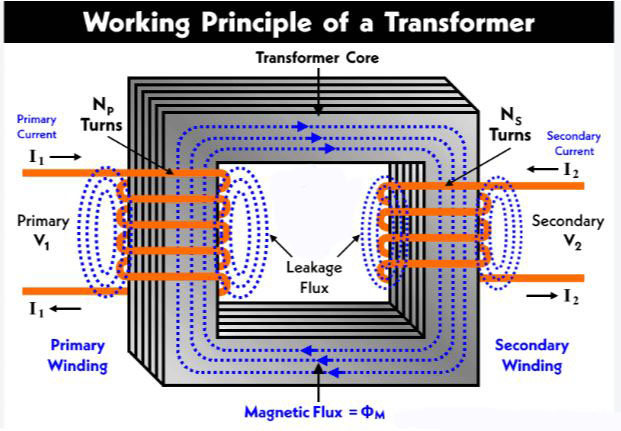
• Transformers: A key feature of AC (alternating current) electricity is the use of transformers, which can increase or decrease voltage with high efficiency. This enables the transmission of electricity over long distances via power grids at very high voltages and low current, thereby minimizing energy loss.
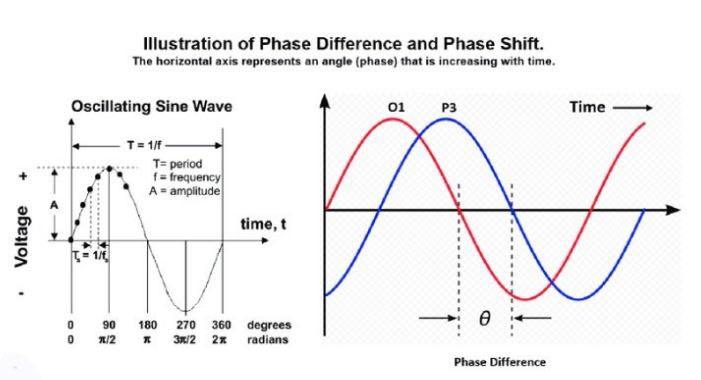
• Frequency and Phase: A key characteristic of AC (alternating current) is its frequency—national power grids typically operate at a frequency of 50 Hz or 60 Hz. AC power can be single-phase (commonly used in residential settings) or three-phase (used for heavy industrial applications and motors).
AC Power Supplies/Station:
1-Ø, 3-Ø -----> 50 Hz / 60 Hz ac
Low & Medium Power Devices --> 400V, 3 - Phase, 50Hz
230V, 1 - Phase, 50Hz
High Power Device --> 3.3kV, 6.6kV, 11kV
Acrerast AC Power Supply - 400 Hz
Electric Traction / Locomotive (Mainline) - 25kV, 50Hz, 1 - Phase
1. List the components of a modern AC power system.
In AC systems, a three-phase, three-wire arrangement is typically used for transmission, while a three-phase, four-wire arrangement is generally used for distribution. The components of a modern AC power system are as follows:
a] Generating station.
b] Step-up station.
c] Transmission line.
d] Switching station.
e] Step-down substation.
f] Primary distribution line or network.
g] Service transformer (or distribution transformer).
h] Secondary distribution line.

2. What is a feeder? What are the characteristics of a feeder line?
An electrical line constructed to supply power from a high-voltage substation or grid substation to various load centers—such as those in densely populated areas, industrial zones, or residential neighborhoods—is called a feeder. In other words, a line that connects a high-voltage substation to a lower-voltage substation is known as a feeder.
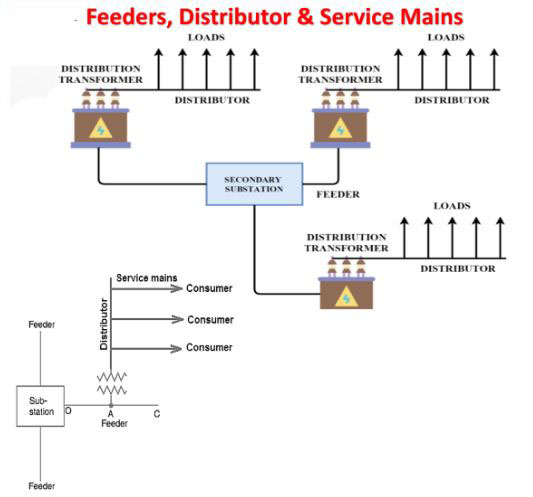
The characteristics of a feeder line are as follows:
1. There are no tappings on the feeder.
2. The current density remains uniform throughout.
3. The design is based on the current (load) at every point.
4. Voltage drop is not given significant priority.
3. What is corona? What are the effects caused by corona?
When two conductors are placed with a spacing greater than their diameter and an AC voltage is applied across them—gradually increasing it—a specific point is reached where the air surrounding the conductors becomes ionized due to electrostatic stress, causing the insulating strength of the air to break down. In this state, a faint, dim, violet-colored glow appears around the conductors, accompanied by a hissing or crackling sound, and ozone gas is produced; this phenomenon is known as corona.
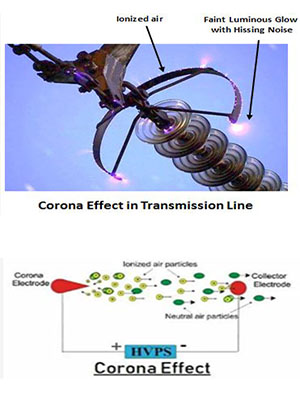
Effects of Corona:
1. Produces a humming or buzzing sound.
2. A violet glow appears around the conductor.
3. Generation of ozone gas.
4. Creation of harmonic currents.
5. Power loss occurs.
Q.4. What are the advantages and disadvantages of the corona effect?
Advantages:
1. It acts as a 'safety valve' for switchgear by limiting the transient effects caused by surge voltages.
2. The corona effect reduces the electrostatic stress between conductors, as the air surrounding the conductors begins to act as a conductor, effectively increasing the virtual diameter of the conductors.
Disadvantages:
1. Power loss occurs
2. Generation of gases
3. Corrosion of conductors
4. Generation of harmonics
5. Interference with nearby communication lines
6. Reduction in efficiency
Q.5. What is corona power loss? Write down the equation.
The power loss that occurs due to the phenomenon of corona is called corona loss. It is denoted by "P".
Equation of Corona Power loss (P) = 242.2 /ð (f + 25) (r/d)½ (V - Vc)2 x 10⁻⁵ kW/km/phase
Here, P = Corona Power loss in Kilowatts per Kilometer per phase (kW/km/phase), f = Supply frequency in Hertz (Hz), ð = Air density factor, r = Radious of the conductor, d = Distance between conductor, V = Operating Phase to Neutral RMS Voltage, Vc = Critical disruptive voltage (RMS per phase)
Q.6. What is the skin effect?
When alternating current (AC) flows through a conductor, it tends to travel along the conductor's surface rather than penetrating its interior; this phenomenon is known as the skin effect. The skin effect increases the resistance of the line, which in turn leads to greater line losses.
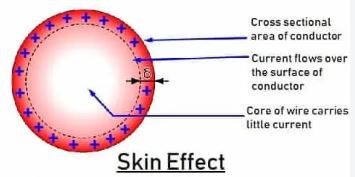
Q.7. Describe the effect of the skin effect in transmission lines. What are the ways to reduce it?
In transmission lines, the skin effect increases the resistance of the line, which in turn leads to an increase in line losses.
Ways to reduce the skin effect:
1. By reducing the radius of the conductor.
2. By using hollow, cylindrical conductors.
3. By using stranded conductors.
4. By using barrel-shaped aluminum conductors.
Q.8. What is the proximity effect? Describe its impact and ways to mitigate it.
When a current-carrying conductor is placed near another current-carrying conductor, the magnetic flux produced by one interacts with the other. This flux causes a greater concentration of current in the halves of the conductors that are closer to each other, compared to the halves that are further apart. As a result, the current distribution across the entire cross-section of the conductors becomes non-uniform, leading to an increase in resistance—much like the skin effect. This phenomenon is known as the proximity effect.
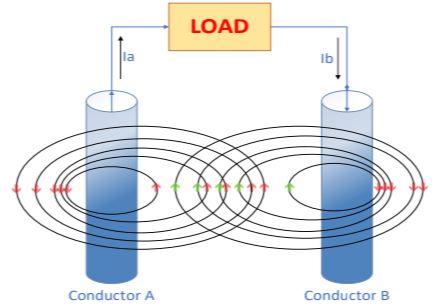
- Impact:
This effect results in an uneven current distribution across the entire cross-section of the conductor; similar to the skin effect, it leads to an increase in resistance and a decrease in self-reactance.
- Methods for reduction:
1. By reducing the frequency range
2. By increasing the spacing between conductors
3. By using stranded conductors
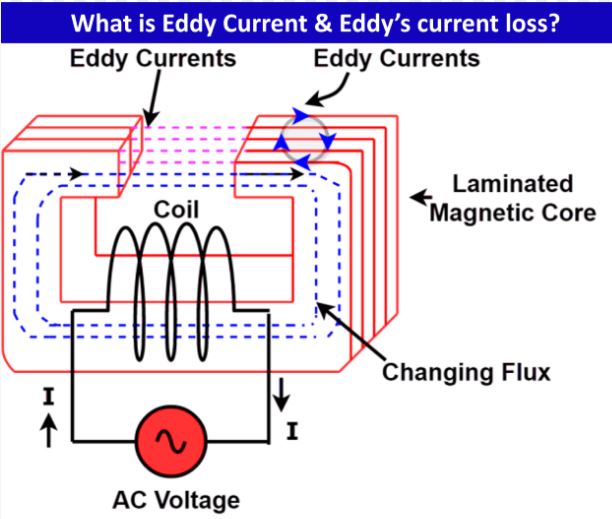
Q. 9. What is meant by eddy current loss?
In addition to hysteresis loss, some energy loss occurs within the core of a magnetic material due to circulating currents, known as eddy currents; this is called eddy current loss.
Q.10. What is electromagnetic induction?
When the magnetic flux associated with a conductor changes, an electromotive force (EMF) is induced within that conductor. If the conductor forms a loop or a circuit, an electric current will flow through it. This process is known as electromagnetic induction.
Q.11. State Faraday’s laws.
First Law: An electromotive force (EMF) is induced in a wire or coil whenever there is a change in the magnetic flux or the magnetic lines of force associated with that wire or coil.
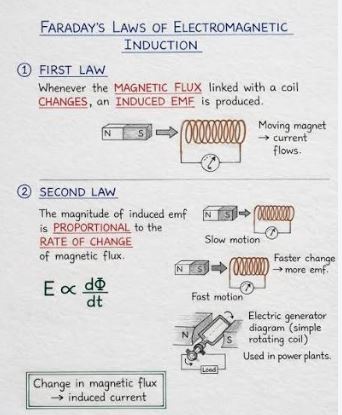
Second Law: The magnitude of the induced electromotive force is directly proportional to the rate of change of the magnetic lines of force.
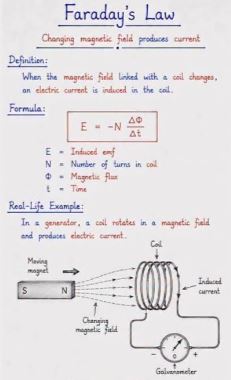
The two principles mentioned above can be combined as follows: when there is relative motion between a conductor and a magnetic field such that the conductor cuts across the magnetic field, an electromotive force is induced in the conductor, the magnitude of which is proportional to the rate at which the magnetic field is being cut.
Q.12. State Lenz's law.
The induced current flowing through a conductor—resulting from an induced electromotive force—creates a magnetic field around the conductor. This magnetic field opposes the very cause that gave rise to the induced current (i.e., the changing magnetic flux).
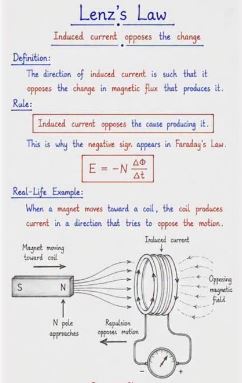
Q.13. Where is Lenz's law applied?
Lenz's law is applied in situations where the conductor remains stationary while the magnetic field is in motion.
Q.14. What is Fleming’s Right-Hand Rule?
If the thumb, index finger, and middle finger of the right hand are extended so that they are mutually perpendicular to each other, and if the index finger points in the direction of the magnetic field lines while the thumb points in the direction of the conductor's motion, then the middle finger will indicate the direction of the induced current flowing through the conductor. This is Fleming’s Right-Hand Rule.
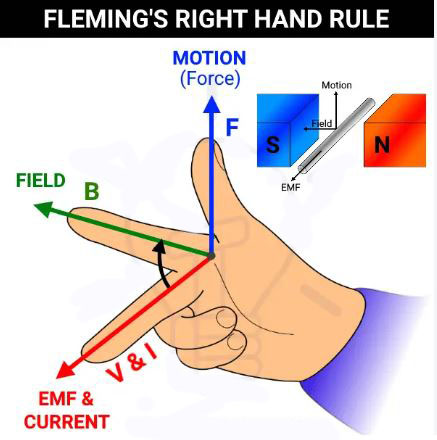
Q.15. Where is Fleming’s Right-Hand Rule applicable?
Fleming’s Right-Hand Rule is applied in situations where the magnetic field is stationary and the conductor is in motion.
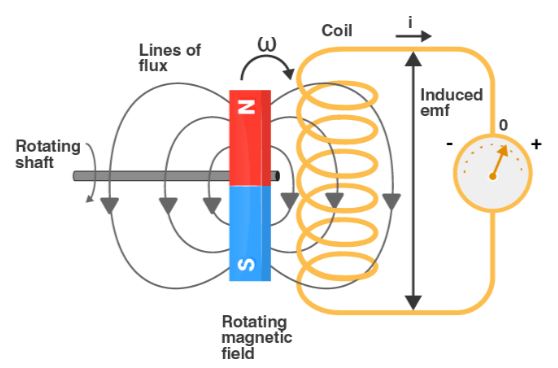
Q. 16. What is mutual inductance?
Mutual inductance is the property by virtue of which a change in current in one of two adjacent coils induces a voltage in the other.
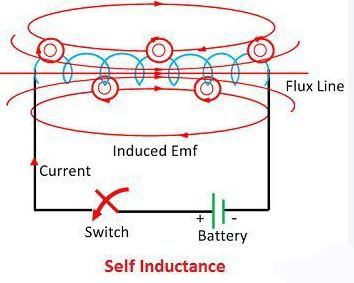
Q. 17. What is self-inductance?
It is a property of a coil that opposes any change either an increase or a decrease in the current flowing through it or in the magnetic flux surrounding it.
Q.18. What is hysteresis?
Hysteresis refers to the tendency of a magnetic material to retain a portion of its magnetic properties.
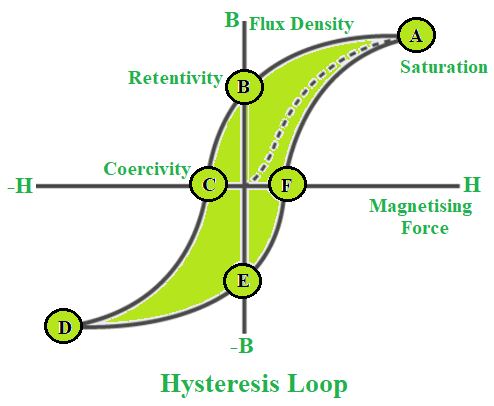
Q.19. What is a cycle of magnetization?
The continuous process of magnetizing a piece of iron, demagnetizing it and then magnetizing and demagnetizing it again repeating this sequence is known as a cycle of magnetization.
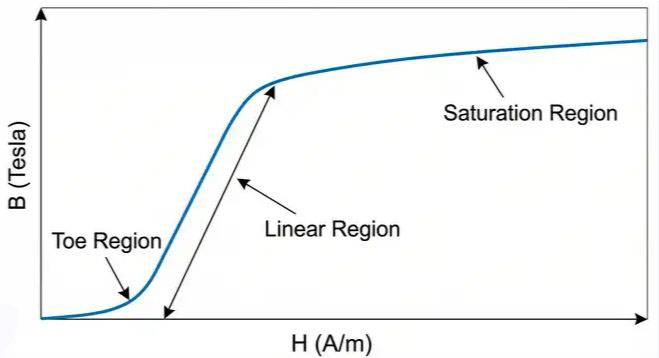
Q. 20. What is a magnetization or B-H curve?
A curve plotted with the magnetizing force (H) on the X-axis and the flux density (B) on the Y-axis is called a magnetization or B-H curve.
Q. 21. What are eddy currents?
When the current flowing through the coil of an electromagnet changes, the magnetic field also changes. This changing magnetic flux cuts across the wire of the coil, inducing a voltage within it. Simultaneously, this flux also cuts across the iron core, inducing a voltage within the core as well. This voltage causes a current to circulate within the iron core; this circulating current is known as an eddy current.
Q. 22. What is meant by eddy current loss?
In addition to hysteresis loss, some energy loss occurs within the core of a magnetic material due to circulating currents, known as eddy currents; this is called eddy current loss.